



Inflation protection (cost-of-living adjustment)

Inflation protection (cost-of-living adjustment)
A pension with inflation protection —also called indexing— means your monthly payments increase over time to help keep pace with rising costs on things like groceries and rent.
Adjustments are not guaranteed, but retired members have received them to date. Increases depend on available funds and could be as low as zero. Once given, each adjustment forms part of a member’s pension for life.
How adjustments are funded
Member contributions go into two accounts:
- Civil Service Superannuation Fund (89.8%)
This account funds pensions. - Cost-of-living adjustment account (10.2%)
This account funds cost-of-living increases.
Employers also contribute to both accounts. Contributions are invested to earn a return.
How increases are decided
Each year, CSSB’s actuary determines if the cost-of-living account can afford to pay an increase and how much it could be. To do this, they look at:
- the money available in the cost-of-living account
- the rules set out in The Civil Service Superannuation Act
The level of increase depends on available funds.
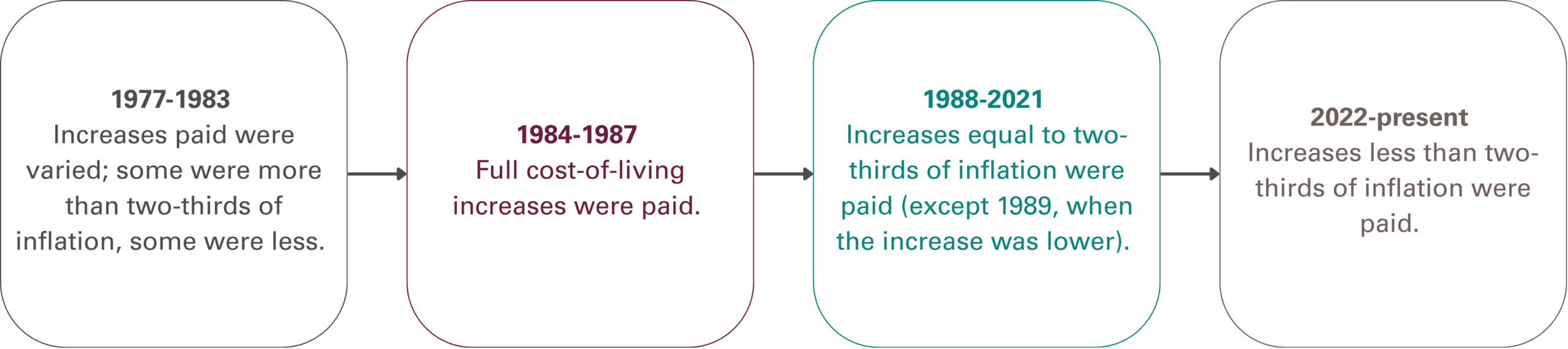
- Full increase: An increase equal to the percentage increase in the Canadian Consumer Price Index (CPI) for the previous year. CPI is a measure of inflation. A full increase is paid only if the account has enough money to cover all cost-of-living payments for the next 20 years.
- Two-thirds of inflation: If there isn’t enough money to cover all cost-of-living payments for the next 20 years, the increase can be no more than two-thirds of the previous year’s CPI.
- What the account can afford: If there isn’t enough money to pay two-thirds of the previous year’s CPI, the increase is limited to what the account can afford.
The actuary shares their recommendation with the Board. The Board can either accept the recommendation or pay a lesser amount.
Canadian Consumer Price Index
Statistics Canada developed the Canadian Consumer Price Index to measure inflation. To do this, they compare the cost of the same goods and services (e.g., food, housing, clothing) at different points in time to see if prices go up.
Payment history
Important to know
- Increases are not guaranteed.
- Once given, increases are part of your pension for life.
- Increases are based on the lifetime pension amount, regardless of the payment option you chose at retirement. If you selected an option that provides a different payment structure (e.g., two-thirds to survivor), your cost-of-living increases will still be calculated based on the original lifetime pension amount.
- When you (a retired member) pass away and your pension continues to a spouse, common-law partner, or other beneficiary, increases reduce to two-thirds or 66.67%.
When increases are given
If a cost-of-living adjustment is approved, your first increase is given in the 13th month after you retire and then every July after that.
- If you have been retired for 13 to 18 months on July 1 (meaning you retired between January 1 and June 30 of the prior calendar year), you will receive a partial increase in the 13th month and in July of the same year.
- When you have been retired for 18 months or more, you will receive a full cost-of-living adjustment in July.
For example, if you retired in April 2023:
- May 2024 – first increase (pro-rated to the 13th month after retirement)
- July 2024 – partial increase (as you have not yet reached 18 months of retirement)
- July 2025 – first full cost-of-living adjustment
This schedule ensures all members eventually align with the plan’s annual adjustment cycle in July.
2026 increase
2026 cost-of-living adjustment: 1.19%
2025 Canadian Consumer Price Index: 2.36%
Cost-of-living adjustment as a percentage of Canadian Consumer Price Index: 50.6%
Pension value over time: full CPI vs. CSSB cost-of-living adjustment
A $1,000 pension that began in 1977 and kept pace with full inflation (based on the Canadian Consumer Price Index) would be worth $5,471 in 2026. With CSSB cost-of-living adjustments, many of which were partial, the same pension would be worth $3,182 in 2026.
Before 1977, cost-of-living adjustments were given on an ad hoc basis.
Why cost-of-living adjustments can’t keep up with CPI
The cost-of-living account hasn’t kept up with inflation for several reasons:
- Periods of higher inflation
- The funding formula
- Changes to membership
- People are living longer
- Pension plan is in deficit and there has been no surplus in over 20 years
Periods of higher inflation
Cost-of-living adjustments are tied to inflation. When inflation rises, the formula allows for larger adjustments. However, funds available in the cost-of-living account don’t increase to cover these larger adjustments.
Example: In 2022, the adjustment was 1.98%. This was the largest adjustment in 19 years. But, because infation was so high that year, it was still less than two-thirds of CPI.
The funding formula
With the current funding formula and plan membership, contributions can’t keep up with granting future cost-of-living adjustments. The recent contribution rate increase will help improve funding, but not enough to address the gap.
Changes to membership
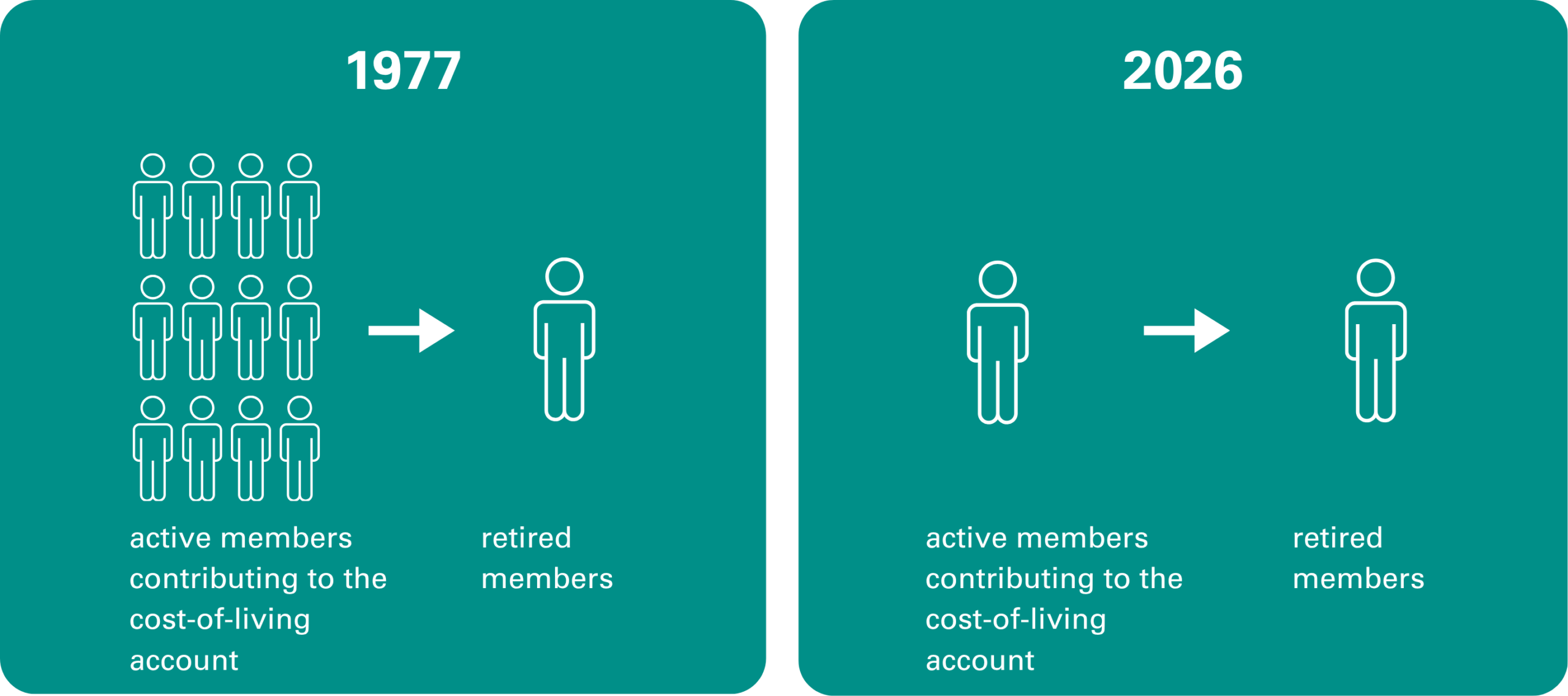
Over the last 30 years, the active to retired member ratio has changed dramatically.
In 1977, there were 12 active members contributing to the account for every retired member receiving an adjustment. Today, there are only 1.2 active members for every retired member receiving an adjustment.
The number of retirees has grown. However, the pool of active contributors has stayed about the same since the mid-1980s.
There are many reasons for this change. People are living longer and collecting pensions for more years. Meanwhile, the number of people employed in the public sector hasn’t grown.
People are living longer
Life expectancy after retirement has risen, meaning pensions are paid for longer.
From 1966 to 2025, life expectancy at age 65 in the Canada Pension Plan increased significantly. It rose by 56% for men (from 13.8 to 21.6 years) and 43% for women (from 16.8 to 24.1 years). CSSB members have experienced similar increases in life expectancy after age 65.
These increases were more than anticipated, so past contributions are not enough to cover today’s costs.
Longer lives are worth celebrating, but pensions are now paid for more years and include more increases over time, which increases costs.
Looking forward
It’s likely that future cost-of-living increases will be paid based on what the account can afford.
How changes are made
Changes to the plan, including changes to the cost-of-living adjustment, require the agreement of two committees:
- Superannuation and Insurance Liaison Committee (representing employees)
- Employer Pension and Insurance Advisory Committee (representing employers)
In addition, both committees must make recommendations to the Manitoba government based on an actuarial report.
Resources


Resources

When it comes to pensions, sometimes there’s no easy substitute for the words used in the industry. We do our…

Inflation protection (cost-of-living adjustment)
A pension with inflation protection —also called indexing— means your monthly payments increase over time to help keep pace with rising costs on things like groceries and rent.
Adjustments are not guaranteed, but retired members have received them to date. Increases depend on available funds and could be as low as zero. Once given, each adjustment forms part of a member’s pension for life.
How adjustments are funded
Member contributions go into two accounts:
- Civil Service Superannuation Fund (89.8%)
This account funds pensions. - Cost-of-living adjustment account (10.2%)
This account funds cost-of-living increases.
Employers also contribute to both accounts. Contributions are invested to earn a return.
How increases are decided
Each year, CSSB’s actuary determines if the cost-of-living account can afford to pay an increase and how much it could be. To do this, they look at:
- the money available in the cost-of-living account
- the rules set out in The Civil Service Superannuation Act
The level of increase depends on available funds.
- Full increase: An increase equal to the percentage increase in the Canadian Consumer Price Index (CPI) for the previous year. CPI is a measure of inflation. A full increase is paid only if the account has enough money to cover all cost-of-living payments for the next 20 years.
- Two-thirds of inflation: If there isn’t enough money to cover all cost-of-living payments for the next 20 years, the increase can be no more than two-thirds of the previous year’s CPI.
- What the account can afford: If there isn’t enough money to pay two-thirds of the previous year’s CPI, the increase is limited to what the account can afford.
The actuary shares their recommendation with the Board. The Board can either accept the recommendation or pay a lesser amount.
Canadian Consumer Price Index
Statistics Canada developed the Canadian Consumer Price Index to measure inflation. To do this, they compare the cost of the same goods and services (e.g., food, housing, clothing) at different points in time to see if prices go up.
Payment history
Important to know
- Increases are not guaranteed.
- Once given, increases are part of your pension for life.
- Increases are based on the lifetime pension amount, regardless of the payment option you chose at retirement. If you selected an option that provides a different payment structure (e.g., two-thirds to survivor), your cost-of-living increases will still be calculated based on the original lifetime pension amount.
- When you (a retired member) pass away and your pension continues to a spouse, common-law partner, or other beneficiary, increases reduce to two-thirds or 66.67%.
When increases are given
If a cost-of-living adjustment is approved, your first increase is given in the 13th month after you retire and then every July after that.
- If you have been retired for 13 to 18 months on July 1 (meaning you retired between January 1 and June 30 of the prior calendar year), you will receive a partial increase in the 13th month and in July of the same year.
- When you have been retired for 18 months or more, you will receive a full cost-of-living adjustment in July.
For example, if you retired in April 2023:
- May 2024 – first increase (pro-rated to the 13th month after retirement)
- July 2024 – partial increase (as you have not yet reached 18 months of retirement)
- July 2025 – first full cost-of-living adjustment
This schedule ensures all members eventually align with the plan’s annual adjustment cycle in July.
2026 increase
2026 cost-of-living adjustment: 1.19%
2025 Canadian Consumer Price Index: 2.36%
Cost-of-living adjustment as a percentage of Canadian Consumer Price Index: 50.6%
Pension value over time: full CPI vs. CSSB cost-of-living adjustment
You can't include multiple times the same chart.
A $1,000 pension that began in 1977 and kept pace with full inflation (based on the Canadian Consumer Price Index) would be worth $5,471 in 2026. With CSSB cost-of-living adjustments, many of which were partial, the same pension would be worth $3,182 in 2026.
Before 1977, cost-of-living adjustments were given on an ad hoc basis.
Why cost-of-living adjustments can’t keep up with CPI
The cost-of-living account hasn’t kept up with inflation for several reasons:
- Periods of higher inflation
- The funding formula
- Changes to membership
- People are living longer
- Pension plan is in deficit and there has been no surplus in over 20 years
Periods of higher inflation
Cost-of-living adjustments are tied to inflation. When inflation rises, the formula allows for larger adjustments. However, funds available in the cost-of-living account don’t increase to cover these larger adjustments.
Example: In 2022, the adjustment was 1.98%. This was the largest adjustment in 19 years. But, because infation was so high that year, it was still less than two-thirds of CPI.
You can't include multiple times the same chart.
The funding formula
With the current funding formula and plan membership, contributions can’t keep up with granting future cost-of-living adjustments. The recent contribution rate increase will help improve funding, but not enough to address the gap.
You can't include multiple times the same chart.
Changes to membership
Over the last 30 years, the active to retired member ratio has changed dramatically.
In 1977, there were 12 active members contributing to the account for every retired member receiving an adjustment. Today, there are only 1.2 active members for every retired member receiving an adjustment.
The number of retirees has grown. However, the pool of active contributors has stayed about the same since the mid-1980s.
There are many reasons for this change. People are living longer and collecting pensions for more years. Meanwhile, the number of people employed in the public sector hasn’t grown.
People are living longer
Life expectancy after retirement has risen, meaning pensions are paid for longer.
From 1966 to 2025, life expectancy at age 65 in the Canada Pension Plan increased significantly. It rose by 56% for men (from 13.8 to 21.6 years) and 43% for women (from 16.8 to 24.1 years). CSSB members have experienced similar increases in life expectancy after age 65.
These increases were more than anticipated, so past contributions are not enough to cover today’s costs.
Longer lives are worth celebrating, but pensions are now paid for more years and include more increases over time, which increases costs.
Looking forward
It’s likely that future cost-of-living increases will be paid based on what the account can afford.
How changes are made
Changes to the plan, including changes to the cost-of-living adjustment, require the agreement of two committees:
- Superannuation and Insurance Liaison Committee (representing employees)
- Employer Pension and Insurance Advisory Committee (representing employers)
In addition, both committees must make recommendations to the Manitoba government based on an actuarial report.